

Key Takeaways:
- Artificial Intelligence is changing the banking and fintech industry by improving customer service, fraud detection, risk management, and operational efficiency.
- AI-powered solutions such as chatbots, predictive analytics, robo-advisors, and automated workflows help financial institutions deliver faster, smarter, and more personalized services.
- Banks and fintech companies can leverage AI to strengthen cybersecurity, enhance credit scoring, automate compliance processes, and make data-driven business decisions.
- Successful AI implementation requires clear business goals, high-quality data, the right technology infrastructure, continuous monitoring, and seamless integration with existing systems.
- Despite challenges such as data security, explainability, and data quality issues, the benefits of AI, including cost reduction, improved customer experiences, and better decision-making, far outweigh the obstacles.
- Emerging trends like autonomous finance, predictive banking, ethical AI, IoT integration, and advanced cybersecurity will continue shaping the future of financial services.
- Organizations that invest in AI today will be better positioned to improve efficiency, reduce risks, and deliver innovative financial experiences in an increasingly competitive market.
| What is AI in Fintech?
AI in fintech refers to the application of machine learning, natural language processing, and predictive analytics within financial services to automate processes, detect fraud, personalize customer experiences, and improve decision-making. |
Banks lose over $485 billion annually to fraud and operational inefficiencies. Artificial Intelligence is helping financial institutions combat these challenges through smarter fraud detection, automated processes, and enhanced customer experiences.
Technologies such as Generative AI, chatbots, and large language models (LLMs) are becoming essential components of modern AI Banking Solutions.
With the AI in banking and finance market expected to reach $49 billion by 2028, organizations are increasingly adopting AI-powered tools to improve efficiency, strengthen security, and deliver more personalized financial services.
How Does AI in Banking and Finance Work?
Ever wondered how AI actually works inside a bank or fintech platform? Here is a simple breakdown.
First, the system collects data, customer details, market trends, transaction records, and financial histories. Then it cleans and organizes this data so the AI can process it accurately, using tools called embedding models, the data is converted into numerical formats and stored in a vector database. APIs and plugins connect different systems together, while an orchestration layer acts as a smart manager that guides the AI toward finding accurate answers.
When someone triggers a query, for example, checking credit risk or flagging a suspicious transaction, the AI searches the data, finds the most relevant answer, and displays it through an app or dashboard. Over time, it learns and improves through continuous feedback.
Advanced AI agents can handle complex multi-step problems, while caching tools help the system respond faster. A validation layer checks every output for accuracy, and everything runs on cloud platforms like AWS or Google Cloud. This is how implementing AI in banking solutions makes finance smarter, faster, and more reliable.
AI in Fintech Industry: Key Statistics
The following statistics highlight the rapid growth of AI in fintech and why financial institutions are accelerating AI adoption worldwide:
- According to Mordor Intelligence, the global AI in fintech market is valued at $36.61 billion in 2026 and is expected to reach $99.09 billion by 2031, growing at a 22.04% CAGR.
- AI-powered chatbots and virtual assistants are the fastest-growing application segment, projected to grow at a 34.8% CAGR through 2031.
- AI consulting, implementation, and managed services are expected to expand at a 27.95% CAGR as financial institutions seek expert AI partners.
- Hybrid cloud deployments are forecast to grow at a 27.4% CAGR, helping organizations balance scalability, security, and compliance requirements.
- Smaller financial institutions and digital banks are expected to grow AI adoption at a 28.6% CAGR through 2031.
- AI usage in payments and remittances is projected to grow at a 32.2% CAGR, driven by real-time payments and compliance automation.
- The Asia-Pacific market is expected to expand at a 33.1% CAGR, making it the fastest-growing region for AI-driven fintech innovation.
- Strong investments from major financial institutions continue to make North America the leading AI fintech market globally.
- AI copilots are expected to reduce model risk management and development timelines by up to 40%, enabling faster deployment of financial models.
- Financial institutions are expected to dedicate up to 30% of AI budgets to governance, risk management, and regulatory compliance initiatives.
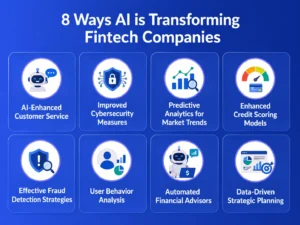
8 Ways AI is Transforming Fintech Companies
AI in Fintech applications is helping companies serve customers better, stay safe from fraud, and make smarter decisions.
There are following 8 simple ways how Artificial Intelligence in Banking & Fintech Applications is making a big difference.
1. AI-Enhanced Customer Service
Many banks and financial apps now use AI-powered chatbots to talk to customers. These chatbots give quick answers, help with money transfers, and even offer financial tips. They are always available and can solve problems without any wait. This is one of the easiest ways AI in banking and finance helps both users and workers.
2. Improved Cybersecurity Measures
Fraud and cyber-attacks are big problems in finance. But AI in fintech services can stop many of these attacks before they happen. AI tools can spot strange patterns in transactions and stop them right away. This makes banking safer and builds trust with customers.
3. Predictive Analytics for Market Trends
AI in Fintech helps companies understand what might happen in the future. It looks at tons of data to find trends in how people spend money or how markets shift. This helps businesses plan better, create smart marketing campaigns, and offer new services at the right time.
4. Enhanced Credit Scoring Models
With AI banking solutions, lenders can now look at more data like mobile usage or social media habits, to decide if someone can repay a loan. This helps more people get loans, especially those without a long credit history. It’s a great way to make financial services fairer for everyone.
5. Effective Fraud Detection Strategies
AI in banking is super smart at spotting fraud. It looks at how people usually spend money and then watches for anything unusual. If it sees something odd, it alerts the bank right away. This stops fake transactions and protects your account. It’s much faster and smarter than old fraud systems.
6. User Behavior Analysis
AI in fintech applications can study how people use their money. For example, it can see what you like to buy or how often you save. With this information, companies can offer products that match your needs, like better savings plans or loan offers. This makes your banking experience more personal and useful.
7. Automated Financial Advisors
Have you heard of robo-advisors? These are smart AI tools that help you manage your money. They give advice, pick investments, and even make trades based on your goals. AI solution tools like this make it easy for anyone to start investing.
8. Data-Driven Strategic Planning
Banks and fintech companies use AI to plan for the future. AI can check all kinds of data from customer habits to market trends and suggest smart moves. This helps businesses grow, save money, and bring better services to users. Implementing AI in banking solutions helps companies make strong, smart plans.

AI Use Cases in the Banking and Financial Services Industry
Artificial Intelligence in Banking & Fintech Applications assist in making things easier and faster than ever. From detecting fraud to giving loan advice, AI in banking and finance is making everything easier for both banks and their customers.
1. Cybersecurity and Fraud Detection
Every day, people use banking apps to send money, pay bills, and shop online. With so many online transactions, there is a higher risk of fraud. That’s where AI in banking helps. It can spot strange or risky activities quickly and alert the bank.
2. Chatbots for Customer Support
AI chatbots are like smart helpers. They talk to customers, answer questions, and solve problems, any time of the day. These bots learn from past chats to improve their answers.
3. Smarter Loan and Credit Decisions
Most banks check your credit score before giving a loan. But sometimes, this score doesn’t show the accurate result. AI in loan lending can look at your spending habits, payment behavior, and even phone data to see if you are trustworthy.
4. Tracking Market Trends
AI in fintech applications can read news, analyze stock prices, and study market behavior to suggest when to invest. It can even warn when there is a financial risk. This helps banks make smart decisions and give better advice to customers.
5. Fast Data Collection and Analysis
Banks deal with huge amounts of data daily. AI can collect, organize, and analyze this data quickly, something that’s hard for humans to do manually. With AI solutions, banks can use this information to detect fraud, improve services, and make better financial choices.
6. Better Customer Experience
People want fast and smooth services. With AI in banking, customers can open accounts, apply for loans, or get financial help without waiting in long lines.
7. Risk Management
Events like economic slowdowns or currency changes can affect banks. With AI expert tools, banks can study past data and predict what might happen next. This helps them make safe decisions and prepare for risks.
8. Regulatory Compliance
Banks must follow many rules to stay safe and legal. But rules change often, and it takes time to keep up. AI can read new legal updates using NLP (natural language processing) and help banks stay on track. It supports human compliance teams by making their work faster and more efficient.
9. Predictive Analytics
AI can find patterns in customer behavior. These patterns help banks find new opportunities to sell more services, improve operations, or solve hidden problems. Predictive analytics is a key part of AI in fintech applications, offering insights that older systems often miss.
10. Process Automation
Banks do many tasks every day that are boring and repetitive. AI banking solutions use RPA (Robotic Process Automation) to complete these jobs faster and without errors.
Real-World Examples of AI in Banking
There are some top banks that are using AI in Fintech and Banking:
- JPMorgan Chase: Uses AI to detect cyber threats like malware and phishing emails before they happen.
- Capital One: Created “Eno,” a smart chatbot that helps with online banking and fraud protection. They also use AI to create virtual card numbers for safer shopping.
- Goldman Sachs & Merrill Lynch: These investment banks use AI to study market trends and improve their trading decisions.
- Alphasense: Many banks use this AI-powered search engine to scan news, reports, and data for business insights.
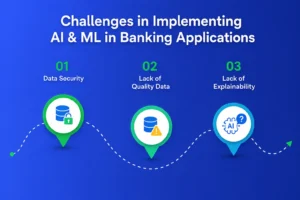
Challenges in Implementing AI & ML in Banking Applications
Even though AI in banking and finance is helpful, it comes with a few challenges.
1. Data Security
Banks store a lot of sensitive information. If the data is not protected well, it can be stolen or misused. That’s why banks need a trusted AI solution provider who also offers strong security.
2. Lack of Quality Data
AI needs clean and structured data to work well. If banks don’t have the right data or if the data is messy, the AI may not give correct results. Banks must improve their data systems before starting with AI banking solutions.
3. Lack of Explainability
Sometimes, AI makes decisions that are hard to understand. If banks can’t explain how AI made a decision (like rejecting a loan), it could create problems. So, banks must make sure their AI in fintech applications are easy to understand and explain.
Benefits of AI in Banking and Fintech Applications
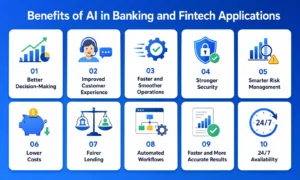
Artificial Intelligence in Banking & Fintech Applications is changing the way banks and financial companies work. AI helps them become faster, safer, and smarter. Here are the main benefits of AI Integration Services in Banking and Finance:
1. Better Decision-Making
AI can quickly study huge amounts of data. It helps banks make smart decisions about loans and investments. This means fewer mistakes, lower risks, and more profits.
2. Improved Customer Experience
AI-powered chatbots and virtual assistants give quick answers 24/7. Customers get help any time, even at night. This builds trust and keeps customers happy.
3. Faster and Smoother Operations
AI automation can handle boring and repetitive tasks like checking documents, monitoring fraud, or approving loans. This saves time, reduces errors, and cuts costs.
4. Stronger Security
AI improves data protection by using smart codes (encryption) to keep customer info safe. It can also spot cyber threats early and stop them before damage is done.
5. Smarter Risk Management
AI can spot early signs of financial risks like missed payments. Banks can act quickly to prevent losses. This helps protect both banks and their customers.
6. Lower Costs
With AI Banking Solutions, banks don’t need as many staff for routine work. AI also helps with smart marketing so banks can attract and keep more customers without spending too much.
7. Fairer Lending
AI makes credit scoring more fair by focusing only on financial data. It avoids unfair judgments based on age, race, or gender, making financial services more equal for everyone.
8. Automated Workflows
AI helps banks run their daily tasks on auto-pilot. This means fewer delays and better service. It’s expected to save banks about $70 billion by 2025.
9. Faster and More Accurate Results
AI is super fast and doesn’t make silly mistakes like humans sometimes do. It helps banks analyze information, spot problems, and serve customers more quickly.
10. Always Available
AI tools, especially when used in the cloud, work all day and night without a break. So, banks can offer nonstop support to customers anytime they need help.
How to Implement AI Solutions in Your Finance Business?
Implementing AI in banking and fintech is like building a smart helper for your business. It takes a few important steps to make sure everything works smoothly. Here’s a simple guide to help you get started with AI banking solutions:
1. Define Your Goals and Use Cases
Start by asking: Why do you want to use AI?
- Do you want to stop fraud quickly?
- Do you want to help customers faster with chatbots?
- Do you want to offer smart saving tips or personal finance advice?
Once you know your goals, pick your AI use cases like fraud detection, risk checks, or automatic loan approvals.
2. Collect and Prepare the Right Data
AI in banking and finance works best when it has clean, correct data.
- Gather information like transaction history, customer profiles, and market trends.
- Check and clean the data. If your data is messy, your AI solution won’t work properly.
3. Build the Right Tech Setup
To implement AI, you need the right tools and technology.
- Set up strong servers and cloud platforms to handle AI tasks.
- Choose the right tools like machine learning, natural language processing (NLP), or data analytics, depending on what your business needs.
4. Develop and Train AI Models
This is where your AI expert team comes in.
- Data scientists and developers create smart models to learn from past data.
- These models improve over time by training with more and better data.
Example: A fraud detection AI will learn to spot fake transactions by studying old fraud cases.
5. Connect AI with Your Current Systems
Your AI banking solutions should work well with the systems you already use like your banking software, CRM, or transaction tools.
- Make sure everything is connected.
- Ensure that data flows smoothly between the old and new systems.
6. Test Everything First
Before using it fully, test your AI in fintech applications in a safe setting.
- See how it performs in real-world scenarios.
- Check if the results are correct and helpful.
7. Monitor and Maintain the AI
Keep an eye on how your AI solution is doing.
- Use real-time dashboards to track performance.
- Update and retrain your models when needed, especially when market behavior changes.
8. Use Feedback to Make It Better
Ask your team and customers for feedback.
- What’s working well?
- What needs improvement?
Use this information to keep making your AI in fintech services smarter and more useful.
Developer Bazaar Technologies is a top AI development company that helps in adding AI in your finance businesses. Whether you want to fight fraud, give smart money advice, or speed up loan approvals, their AI experts can create custom tools that work just for you.
Future Trends of AI in Banking
The future of AI in Banking and Fintech looks very exciting. There are various future trends of AI that are coming in this competitive market in near future.
1. Generative AI Compressing Risk Management Timelines
Generative AI copilots are already shortening model-risk-management cycles by up to 40%, drafting documentation, parsing regulatory text, and assembling validation packs in hours rather than months. Institutions that deploy these tools gain a measurable speed advantage in releasing compliant risk and credit models.
2. Autonomous Finance
AI will increasingly manage routine financial decisions on behalf of customers, automatically optimizing savings, adjusting investment allocations, and managing bill payments based on individual financial goals and behavioral patterns, with minimal human input required.
3. AI and Open Banking
As open banking mandates expand globally, including PSD3 in Europe, AI will become the intelligence layer interpreting data shared across financial institutions, enabling richer credit assessments, more competitive product matching, and hyper-personalized customer offers.
4. Hybrid Cloud Deployment as the Default Architecture
Financial institutions are moving toward hybrid AI architectures, running training pipelines on-premise for data sovereignty while using cloud infrastructure for inference at scale. This approach is growing at a 27.4% CAGR and is becoming the standard for regulated environments globally.
5. SME and Neo-Bank AI Adoption
Lower-cost, pay-as-you-go AI platforms are bringing enterprise-grade capabilities to smaller financial institutions and challenger banks. SMEs and neo-banks are projected to grow AI spending at a 28.6% CAGR through 2031, the fastest adoption rate of any segment by organization size.
6. AI-Driven Regulatory Compliance (RegTech)
AI tools are automating an increasing share of compliance monitoring, regulatory reporting, and audit preparation. With institutions now receiving an average of 234 regulatory notices daily, AI is no longer optional for compliance teams, it is essential infrastructure.
7. Ethical AI and Algorithmic Transparency
Regulators globally, including under the EU AI Act, are requiring explainable, auditable AI decisions in financial services. Institutions that invest now in ethical AI frameworks and bias auditing will have a compliance advantage as governance requirements tighten through 2031.
8. Advanced AI Cybersecurity
Next-generation AI security systems are moving from reactive threat detection to predictive threat prevention, identifying attack vectors and closing vulnerabilities before breaches occur. As financial cybercrime grows in sophistication, AI-powered security is becoming a core infrastructure investment.
9. AI in Payments and Remittances
Payments and remittances providers are projected to grow AI adoption at a 32.2% CAGR through 2031, the fastest rate among all end-user segments. Real-time cross-border payment rails generate continuous behavioral data that AI uses to improve fraud detection, compliance screening, and liquidity forecasting simultaneously.
10. Central Bank Digital Currencies and AI
As central banks globally explore digital currencies, AI will play a critical role in transaction monitoring, fraud prevention, and monetary policy analysis within CBDC ecosystems, creating an entirely new category of AI application in financial infrastructure.
Conclusion
Artificial Intelligence in Banking & Fintech Applications is changing the financial world for the better. From improving customer service to protecting data and reducing costs, AI in Fintech makes banks smarter and more helpful.
As AI continues to grow, banks will offer even more useful, safe, and personalized services. With the help of the right AI solutions and experts, banks can keep moving forward and serve their customers better than ever.

FAQs
1. How can AI reduce false positives in fraud detection systems?
AI analyzes customer behavior, transaction history, device information, and spending patterns in real time. Unlike traditional rule-based systems, AI continuously learns from new fraud cases, helping banks distinguish between genuine and suspicious activities more accurately. This reduces unnecessary transaction blocks while improving fraud prevention.
2. What data is required to successfully implement AI in banking and fintech applications?
AI models require access to transaction records, customer profiles, credit histories, support interactions, and market data. The quality, accuracy, and consistency of this data directly impact AI performance. Financial institutions should establish strong data governance practices before deploying AI solutions to ensure reliable outcomes.
3. Can AI help financial institutions meet regulatory and compliance requirements?
Yes. AI-powered compliance solutions can monitor transactions, identify suspicious activities, automate reporting, and analyze regulatory updates. This reduces manual workloads for compliance teams while improving accuracy and helping financial organizations stay compliant with evolving industry regulations.
4. What is the ROI of implementing AI in banking and fintech operations?
The return on investment comes from reduced operational costs, improved fraud prevention, faster loan processing, better customer retention, and enhanced productivity. AI also enables banks to automate repetitive tasks, allowing employees to focus on higher-value activities that drive business growth and profitability.
5. How long does it take to implement an AI solution in a financial business?
The timeline depends on the complexity of the use case, data availability, regulatory requirements, and integration needs. Simple AI implementations such as chatbots may take a few months, while enterprise-grade fraud detection, credit scoring, or predictive analytics platforms can require six months to a year or more for full deployment and optimization.